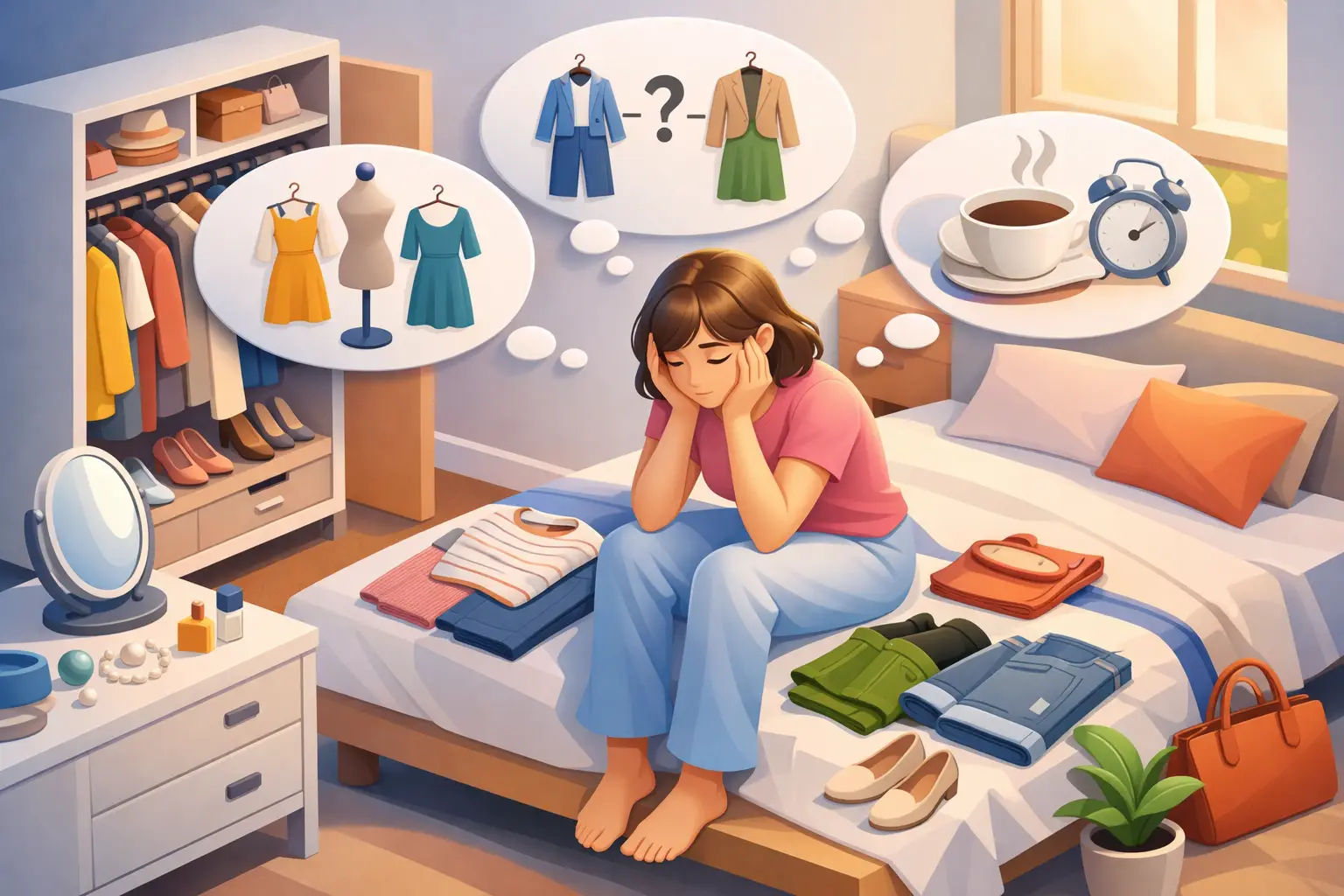
The 8:12 a.m. stare into a full closet is rarely about having nothing to wear. It is about having too many decisions to make before your day has even started. If you are wondering how to reduce outfit fatigue, the answer is not buying a whole new wardrobe. It is making your existing wardrobe easier to see, combine, and trust.
Outfit fatigue happens when every morning asks you to solve the same problems from scratch: What works for the weather? What feels like you? What looks polished enough? What have you worn recently? A few simple systems can turn that mental pileup into a quick, confident choice.
Why outfit decisions feel so draining
Getting dressed looks simple from the outside, but it is a chain of small choices. You are choosing a base, a layer, shoes, a bag, jewelry, and often a version of yourself that fits the occasion. Add time pressure, laundry, an unpredictable forecast, and clothes that no longer fit your life, and the decision gets heavier.
A cluttered closet makes the problem worse. When your best pieces are buried among items that do not fit, need tailoring, or never feel right, every choice takes longer. You may keep reaching for the same safe outfit, not because you lack style, but because it is the only option you can evaluate quickly.
The goal is not to make every outfit identical. It is to remove low-value decisions so you have more energy for the creative ones.
Start with a wardrobe you can actually use
You do not need to organize every drawer in one weekend. Begin by separating the clothes you actively wear from the clothes that create hesitation. Pull out anything that is uncomfortable, damaged, the wrong size, difficult to style, or saved only for a version of your life that has passed.
That does not mean you need to donate everything immediately. Create a temporary “not now” section instead. Store seasonal pieces, repair candidates, and uncertain items separately for a month or two. Once they stop crowding your daily options, you can see what your real wardrobe looks like.
Next, make your everyday clothes visible. Keep current-season staples at eye level and group similar categories together: shirts with shirts, pants with pants, layers with layers. This small reset lowers the friction of getting dressed because you stop searching before you start styling.
If you have a lot of clothing, a digital wardrobe can help even more. Photographing and cataloging your pieces makes it possible to browse your closet from your phone, including the jacket that is hanging behind three coats or the jeans currently in the laundry. Visibility is one of the fastest ways to make underused clothes useful again.
Use your best colors as a shortcut
Color uncertainty is a quiet source of outfit fatigue. A top may fit perfectly, but if the shade makes you look washed out, you will try it on, reject it, and move on. Repeat that process with five more pieces and the morning is already gone.
Build around colors that consistently work with your skin tone, hair color, and natural contrast. You do not need to limit yourself to a tiny palette or wear only neutrals. You just need a reliable group of shades that make mixing easier and help you feel good without a second opinion.
Choose two or three neutral base colors that work together, such as black, cream, and denim, or navy, gray, and soft white. Then add a few accent colors you genuinely enjoy wearing. When most of your tops, bottoms, and layers speak the same color language, combinations appear faster.
This is where personal color analysis can be practical rather than precious. Knowing your strongest colors gives you a filter for purchases and a faster way to choose from what you already own. If a color is outside your usual range but you love it, wear it as a bag, shoe, skirt, or layer instead of placing it right next to your face.
Build outfit formulas, not uniform outfits
An outfit formula is a repeatable structure, not a rigid dress code. It gives you a dependable starting point while leaving room to change the color, texture, or mood. Think of it as your shortcut when your brain is busy.
For a casual workday, your formula might be straight-leg jeans, a fitted tee or knit, an overshirt or blazer, and clean sneakers or loafers. For a dinner plan, it could be tailored pants, a simple top, a statement layer, and one elevated accessory. For class or errands, try relaxed pants, a close-fitting top, an open layer, and comfortable shoes.
Create three to five formulas based on the places you actually go. A student with campus days, part-time shifts, and weekend plans needs different formulas than someone who works in a creative office or travels regularly. The right system reflects your schedule, not a generic capsule wardrobe on social media.
Once you have your formulas, identify the pieces that fill each role. Maybe two pairs of pants work with nearly every top you own. Maybe one cropped jacket instantly makes casual basics look intentional. These are your high-utility pieces. Keep them clean, accessible, and in good repair.
Plan outfits before the morning rush
The most effective way to reduce outfit fatigue is to move the decision to a calmer moment. Spend 10 to 15 minutes once or twice a week checking your calendar, the weather, and your laundry situation. Then select outfits for the days that matter most.
Start with anchor events: presentations, dates, office days, flights, workouts, or any occasion where you want to feel especially prepared. Build those looks first. Then choose easy default outfits for open days, when your plans may change.
Lay out complete looks if you have the space, including shoes and outerwear. If not, take a mirror photo or save a quick note on your phone. The point is to avoid reconstructing the outfit from memory at 7 a.m.
Planning does not need to remove spontaneity. Leave one or two days unplanned if you enjoy dressing by mood. But give yourself a small menu of ready options: a polished default, a comfortable default, and a weather-proof default. Choice still feels good when the choices are already strong.
Create a fast decision rule for hard mornings
Even a great system has rushed days. For those moments, use a simple rule: pick one anchor piece, then complete the outfit with familiar partners. The anchor could be a favorite pair of pants, a jacket, a color, or a shoe you want to wear.
If you choose wide-leg black pants, you already know the next moves: fitted knit, white tee and blazer, or a monochrome black top with a textured layer. You are not asking, “What can I possibly wear?” You are asking, “Which version feels right today?” That is a much easier decision.
Keep a few no-fail outfits documented for different conditions. Have one for warm weather, one for cold weather, one for rain, and one for an occasion that needs a sharper look. These are not boring backups. They are your personal style safety net.
Stop buying pieces that create more work
New clothes can briefly feel like a solution, then create another round of decisions. Before buying anything, ask whether it works with at least three items you own now. Consider the shoes, underwear, layers, and care requirements too. A beautiful top that needs a specific bra, a specific jacket, and hand-washing may not make weekday dressing easier.
The exception is a true statement piece that brings you joy. Not every purchase needs to be practical. But your core wardrobe should carry the daily workload, while expressive pieces add variety without demanding a full styling project.
When you notice an outfit you love, save it. Take a photo, note why it worked, and repeat the logic later. Over time, you will build proof of what suits your body, your coloring, and your routine. That is more valuable than chasing a new trend every week.
Getting dressed should not be the first exhausting task of the day. A clearer wardrobe, a few dependable formulas, and a plan that matches your real schedule can make your style feel more personal and far less demanding.
Want your wardrobe decisions in one place? Use SHMOT to scan your style, organize your clothes, try outfit ideas, and plan looks before the week starts.